
Analytical Studio for Compound QC
Confirm compound identity and purity at scale, before it becomes a downstream problem.
Introduction
High-throughput synthetic chemistry can generate thousands of compounds for analytical evaluation. Before those compounds move into assays, screening collections, or downstream studies, the analytical team needs to answer two basic questions: is the expected compound present, and does it meet the laboratory’s quality criteria?
Processing and reviewing results from 2,000 to 5,000 LC/MS samples per week manually is not practical.
Virscidian’s Analytical Studio automates routine compound QC by combining LC/MS data processing, MS-based substance assignment, chromatographic assessment, and configurable decision rules in a single environment. Instead of manually reviewing every sample, scientists can apply consistent acceptance criteria across entire plates. Results that meet their defined criteria can be accepted automatically, while samples that require scientific judgment are surfaced for review.
By encoding each lab’s acceptance criteria into Analytical Studio’s expression engine, you replace subjective, scientist-by-scientist variation with a consistent, transparent, and reviewable decision process.
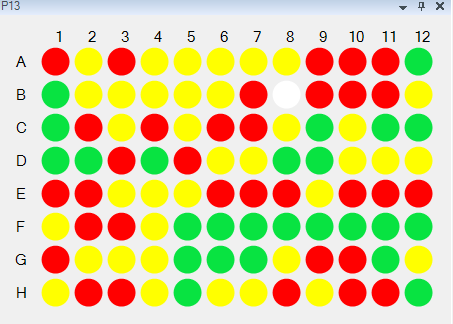
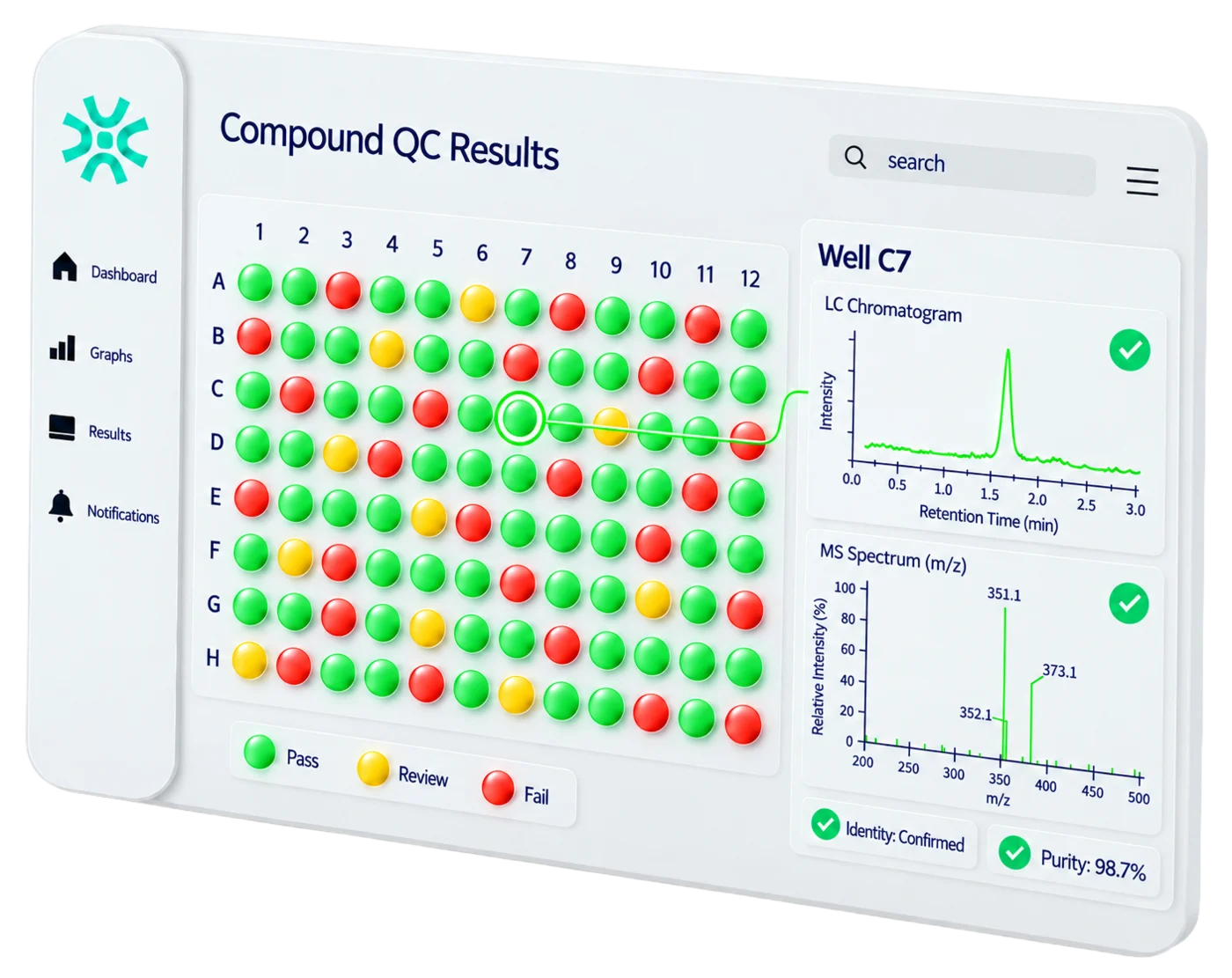
Color-coded plate views summarize compound QC results across an entire sample set for rapid review
Features
Plate-Level Review by Exception
In a high-throughput QC environment, the goal isn’t to eliminate scientific review but to eliminate unnecessary scientific review.
Reviewing every chromatogram in every plate is time-consuming and brings little value if most samples meet acceptance criteria. Analytical Studio’s review-by-exception model addresses this directly. Color-coded plate views provide an immediate overview of each batch, applying defined decision criteria consistently across all samples and distinguishing passing results from those that don’t meet laboratory specifications, impurity coelution, isomers, chromatographic peak shape, or other configurable conditions. Scientists can view an entire plate at a glance and move to the next without opening a single chromatogram individually, unless a sample warrants it.
When a sample does require further investigation, scientists can select individual wells and review the underlying data and calculations. Automated decisions remain transparent and traceable back to the analytical data, preserving scientist oversight of uncertain or problematic results.

Side-by-side plate views compare analytical outcomes and highlight samples that require further review.
Automated Compound Confirmation
Chromatographic purity alone does not establish that the expected compound is Present.
Analytical Studio automatically assigns substances by comparing experimental MS data with information about the expected compound, including theoretical isotope patterns and adducts. Rather than returning only a generic pass or fail, Analytical Studio can distinguish analytical conditions that require different follow-up actions. This gives analysts more useful information than a simple failure flag and helps direct their attention to the appropriate next step.
By automatically separating confirmed results from those requiring scientist attention, Analytical Studio helps compound QC teams move through large sample sets without manually interpreting every chromatogram and spectrum.
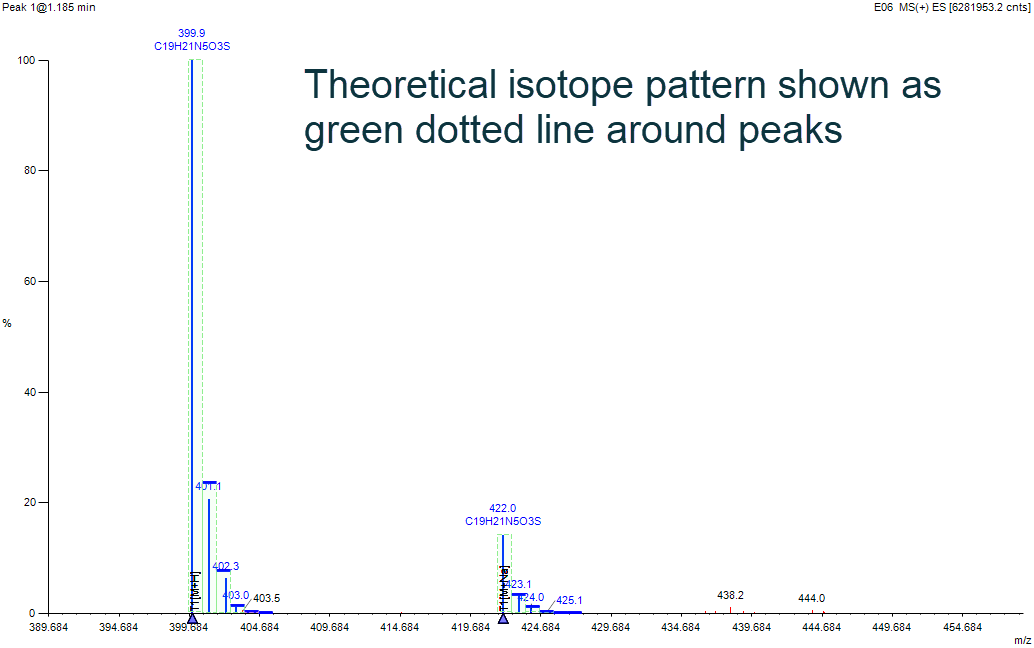
Mass spectral data support automated compound confirmation through target-ion and isotope-pattern evaluation.
Chromatographic Purity and Peak Quality
Analytical Studio calculates chromatographic purity and evaluates peak quality using configurable Expressions, lab-defined rules and thresholds applied consistently across samples, instruments, and sites.
Asymmetry thresholds, peak resolution values, and detector-specific criteria are defined once and applied automatically. Two samples that look similar by eye but fall on different sides of a defined threshold are treated differently, and the reasoning behind decisions is transparent and traceable. The inconsistency that comes from individual scientists setting their own acceptance criteria, or from eyeballing a peak, is replaced by a unified set of rules that every instrument and every site uses.
Samples with coeluting impurities, significant peak tailing, or UV/MS signal inconsistencies are flagged for review. Samples that meet all defined criteria pass automatically, with the Expression results available to explain the decision.
Every laboratory defines acceptable compound quality differently, and Analytical Studio does not require teams to adopt a fixed set of hardcoded rules. Expressions allow laboratories to encode their own calculations, thresholds, Boolean logic, and decision criteria directly into the processing workflow. Those rules can incorporate experimental data, sample metadata, calculated metrics, and target-compound information to produce pass/fail results, review flags, and workflow decisions. Once defined, the same criteria apply automatically across large sample sets, standardizing interpretation between scientists, instruments, methods, and locations. As requirements change, Expressions can be updated without redesigning the analytical workflow.

Defined peak-shape criteria distinguish passing results from samples that require review, even when differences are difficult to assess visually.
One Data Processing Environment Across Multiple Instrument Vendors
Compound QC laboratories often operate analytical instruments from multiple vendors. Analytical Studio supports analytical data from major instrument vendors used in pharmaceutical discovery, including Agilent, Waters, Shimadzu, Thermo Fisher, SCIEX, and others.
Instead of requiring analysts to review results separately in each vendor’s software environment, Analytical Studio brings supported chromatography and mass spectrometry data into a common processing and review environment.
The practical advantage is not simply file compatibility. It is the ability to apply a consistent analytical framework across a heterogeneous instrument fleet.
Scientists work within one analytical environment, while laboratories can standardize decision logic where appropriate regardless of which supported instrument generated the data.

Have an instrument or data format you do not see listed? Talk to us about your environment and workflow.
Automated Sample Management and Walk-Up LC/MS
In many high-throughput QC workflows, significant manual effort occurs before the analytical data is ever generated.
Compound information may need to move from an ELN, synthesis platform, robotics system, or internal database into instrument-specific sample lists. After acquisition, results then need to move back into the systems used by chemists.
Analytical Studio can transfer compound metadata and other experiment information between Analytical Studio and external systems, then combine that metadata with acquisition and processing-method information to generate instrument-ready sample lists for multiple LC/MS vendors. This removes manual sample-list preparation, eliminates transcription and file-conversion errors, and returns processed results to downstream systems without manual data transfer.
These capabilities support automated, walk-up LC/MS workflows in which scientists submit samples, instrument-ready lists are generated, instruments acquire data, Analytical Studio processes the results, and analytical information is returned to the appropriate downstream system, all without routine manual handling between steps.
The practical result is the ability to run high-throughput LC/MS environments involving instruments from multiple vendors within a connected analytical workflow.
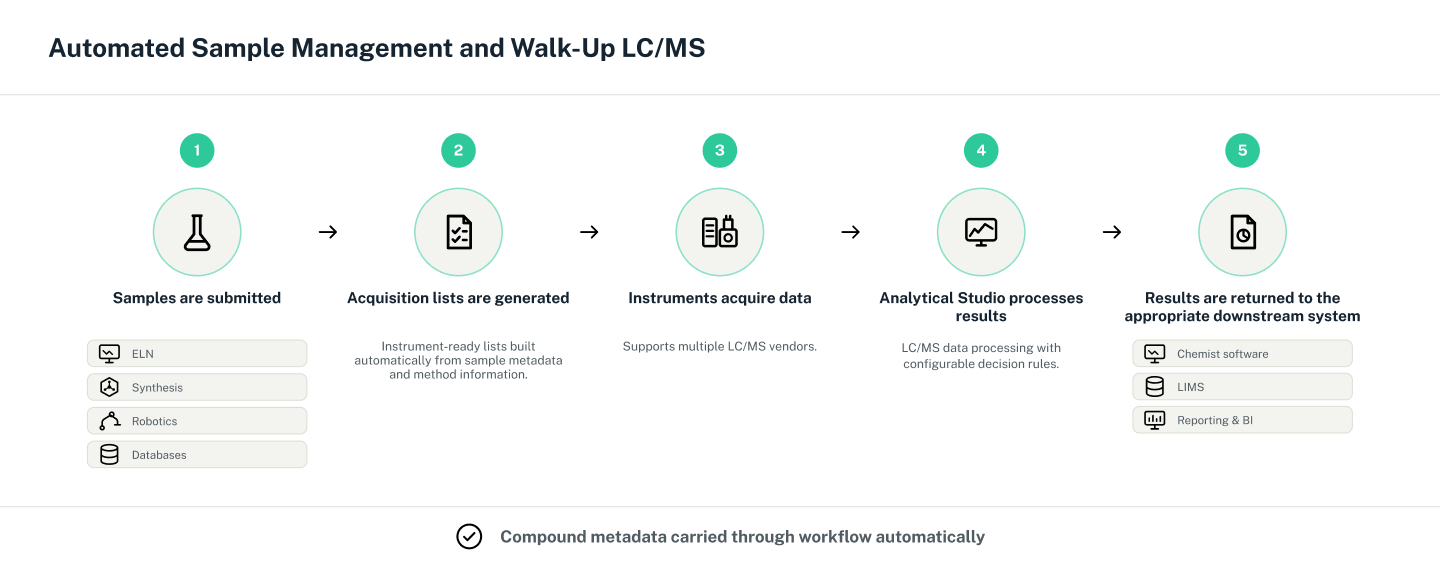
Analytical Studio transfers compound metadata between external systems and Analytical Studio, eliminating manual data entry errors.
Configurable Reporting
Tailored reports can be automatically generated after each sample, each plate, or each experiment. Report templates are standardized and reusable, consolidating results from all stages and instruments into a single output in a variety of formats without manual assembly.

Configurable reporting consolidates analytical results into standardized, reusable outputs for samples, plates, and experiments.
Automating High-Throughput LC/MS QC for Rapid Drug Discovery
A biopharmaceutical discovery organization operating at very high synthetic throughput needed to perform LC/MS QC on 2,000 to 5,000 samples per week without making manual sample-list preparation and data transfer a bottleneck.
Its existing process relied on Excel-based sample lists and separate LC/MS methods and workflows for different instrument vendors.
Virscidian worked with the organization to implement an automated LC/MS workflow connecting Analytical Studio with its chemistry software, internal database, and analytical instrumentation.
The resulting workflow removed manual sample-list assembly and manual result transfer from the routine QC process. Analytical Studio automatically processed the acquired LC/MS data and returned the required analytical information to downstream Systems.
Today, the organization processes 2,000 to 5,000 LC/MS samples per week through the automated workflow and has subsequently expanded the implementation to additional LC/MS capabilities.
“Our goal was a fully automated, high-throughput LC/MS workflow that scales to thousands of samples per week. Thanks to Virscidian’s software and integration expertise, we’ve reached that level of efficiency, and we’re prepared to take on even More.”
Read the full case study →
Virscidian Resources


Used by companies worldwide
Partner With Us
We partner with you to provide customized informatics solutions that use Analytical Studio to enhance decision making and accelerate your workflows.

