
A Direct-to-Biology Amine−Acid Amination for Rapid Phenotypic Profiling of Lysosomotropic Natural Products
Explore a direct-to-biology amine–acid amination workflow for rapid phenotypic profiling of lysosomotropic natural products in drug discovery
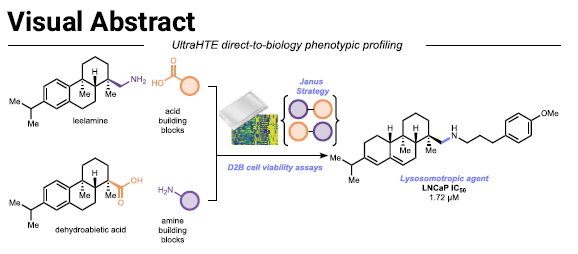
Natural products (NPs) are foundational to drug discovery, owing to their diverse molecular scaffolds and novel bioactivities. However, optimizing NPs for optimal bioactivity and improved drug properties is hindered by material scarcity and labor-intensive purification processes. Here, we present an automated ultrahigh-throughput experimentation (ultraHTE) and directto-biology (D2B) platform that enables rapid structure−activity relationship (SAR) mapping from miniaturized libraries of synthetic NP analogues, unlocking NPs as a viable starting point for late-stage diversification in drug-lead optimization. Starting from leelamine, a conifer resin-derived tricyclic diterpene with prostate cancer antiproliferative activity, we synthesized leelamine analogues in a 1536-well format, achieving a 73% success rate while consuming only 0.03 mg of NP per reaction. Key to success was the development of a platinum-catalyzed amine−acid reductive amination reaction, which performed well on both amine and complementary acid-derived NPs, in a so-called Janus strategy which more than doubled the accessible chemical space. Direct phenotypic screening in LNCaP cells enabled rapid identification of potent, cell-permeable analogues with robust quality control achieved through iterative resynthesis on preparative scale. SAR insights revealed two key substitution patterns driving potency based on 4-methoxyphenyl and 3-indolyl derivatives. Mechanistic studies—including androgen receptor binding, chemoproteomics, and a lysosomal cholesterol colocalization assay—demonstrated distinct modes of action for optimized analogues compared to leelamine. Collectively, this amine−acid amination-based D2B platform showcases accelerated SAR elucidation from minimal material and cellular profiling, unlocking a framework for mechanism-driven lead discovery in NP chemical space.


Additional Resources


We partner with you to provide customized informatics solutions that use Analytical Studio to enhance decision making and accelerate your workflows.

